
Why Democracy Works
What "A Knight of the Seven Kingdom", American constitutional politics, and revolutions in industrialization have to do with the future of good governance...yes, really

Amid the mess of Earth that is the world in 2026, I recently found some joy in watching the new Game of Thrones show, “A Knight of the Seven Kingdoms”. If you’ve heard anything about this new show it’s probably something about how the joyful, self-contained little story is a breath of fresh air for a franchise at risk of feeling stale. Which is all true by the way. But if you’re the sort of rambling nerd like me who can’t help gobbling down lore and destroying a good night’s sleep diving into wiki entries, then A Knight of the Seven Kingdoms also threatens to open up questions about governance, history, economics, and what it means to build a stable society in an age of rapid and accelerating change.
Let’s get into it.
Down the Rabbit Hole We Go
Despite the intro (and the cover image) I promise this isn’t really an article about fantasy or Game of Thrones at all. But humor me for a minute, as I establish some context. Also no spoilers here, I promise.
For the sake of this article, all you really need to know about “A Knight of the Seven Kingdoms” is it involves a knight (duh) and also a few members of the mythical royal family of medieval Westeros— the Targaryens. We’ve seen other members of this royal bloodline with Daenerys and Viserys in the original “GoT” series, as well as many others in the follow up series “House of the Dragon”. But with “A Knight of Seven Kingdoms” I finally realized I didn’t actually understand the chronology of this made-up fantasy world. And so, against my better judgement, I decided to open up Google for (what I hoped to be) some light Sunday reading. Eventually though I found my way to the deeply self-serious and horrifically sweaty fan-site…”A Wiki of Ice and Fire”.
This is where things started to go wrong. For my peace of mind and - most of all - for my sleep schedule.
Originally I just wanted to answer a few simple questions. How were these new fictional royals connected to those other fictional royals? Are these grandparents, great grandparents? I was curious, so I started digging.
And to the surprise of no one who’s actually read Game of Thrones, I quickly realized something dark and fundamental about this fucked up royal family:
The “Targaryen family tree” is much less a straight and sturdy oak, and more a mangled snarl of tangled vines — intertwining, self-smothering, burned away in some places, whole branches lopped off in others, and almost everywhere stained in blood, soot, and tragedy.
Basically what I learned is that despite their long and illustrious history, the Targaryens are only only good at murder, incest, and civil war. To be clear: these are not the sort of people you want running your country.
George R. R. Martin’s world of Ice and Fire is famous for its depravity — the cruelty of its politics, the realism of its stakes, and the gray morality of its characters. But the Targaryen’s specifically are really famous for two things: incest, and dragons.
Obviously dragons are creatures of fantasy (to the great disappointment and slow acceptance of my eight-year-old self). But incestuous royal families are all-too-common both in our world and the fictional lands of creative fantasy. That’s because in the weird logic of dynastic power politics, marriage between family members almost makes a perverse sort of sense.
Marriage for political purposes is one of the cornerstones of human civilization. That’s because there really is no better way to turn an enemy into an ally than to bind the future of their lineage with the future of your own.
But in much the same way, marriage is also…risk. Bringing outsiders into your royal games injects instability, brings more players to the table, and also dilutes the importance of your own royal bloodline. Moreover — as regimes are long, and proud old families are loath to pair offspring with any but the finest pedigrees — elites have a way of narrowing their genepool.
European history is full of stories of inbred aristocrats suffering from the spoils of the long insularity: Romanovs died from papercuts, cursed by their indemic hemophilia; Habsburgs were famous across the continent for a distinctive jawline that persisted despite the fact it literally made it hard for them to eat.
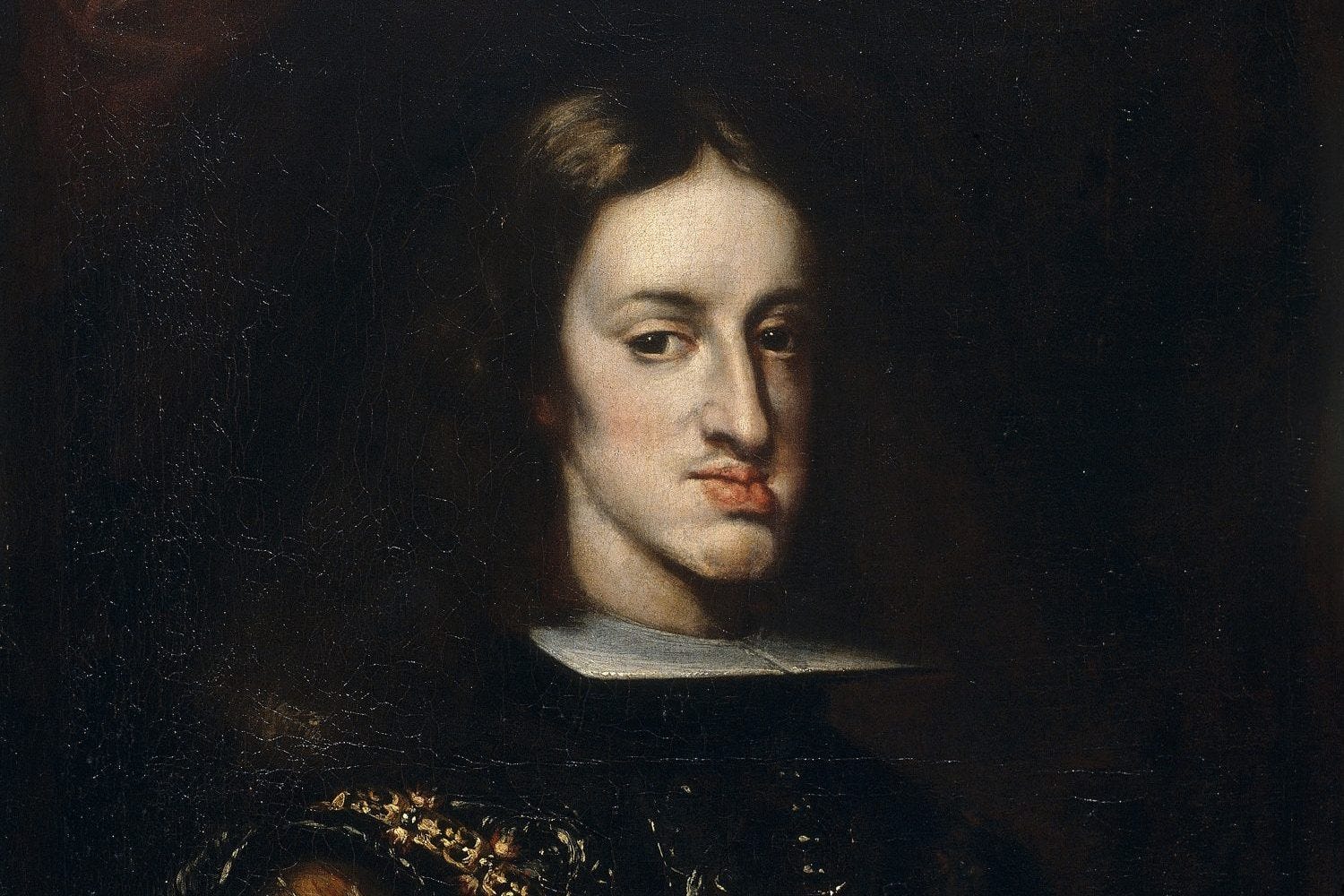
What’s interesting to me though isn’t just the fact aristocrats hurt themselves with their short-sighted decisionmaking. The absolute power of old-age aristocrats means that the simple weirdness of these people also had huge and cataclysmic impacts on the societies they governed.
Why You (Really, really) Don’t Want a King
Both real and fictional monarchies are plagued by the same recurring motif: gambling your society’s wellbeing on the sanity of one individual isn’t really the best idea.
I will caveat that I think we moderns often assume “absolute” monarchs had a far more absolute grasp on power than they really did. Even hundreds or thousands of years ago, there were still systems in place to keep things running smoothly from one monarch to the next. Diplomats and business people, religious leaders and tax collectors, generals and grand viziers. All the people that made up “The System” would generally stay in play when the crown passed from father to son. And sometimes even when it was yanked from conquered to conqueror.
Whether it’s the 21st century or 2,000 BC, people like stability.
It’s because of this fact that history is full of monarchs that “The System” kept fat and happy. A council of established leaders might flatter an incoming monarch —giving them deference and ample affirmation — while quietly maintaining their own systems of management much the same from one king to the next. History marks the turning of the age from King James I to King James II, but all the while “the System” does its job and makes sure almost nothing changes.
Until, something does change.
Maybe a king grows uneasy. He becomes petty, vindictive, or skeptical of council. His advisors (most often ambitious aristocrats in their own right) might overstep, making the mighty king feel like more of a ward than a monarch. In return he might remove them, strip them of office or of honors. Maybe he spurns political marriages between their children and his.
Or maybe a king becomes too convinced of his own divinity? What happens when a monarch really believes they can govern absolutely?
Both in fantasy and reality there are hard rules in the governance of a realm. Soldiers come from somewhere, and so do taxes. If a ruler spits in the eye of those who control the flow of iron and gold, they roll the dice in the great game of history. And when people are pawns and even kings are just one piece on the gameboard of continents, the dealer always gets their due, and the House is greedy for its take.
The simple truth in systems of power is: stability builds wealth and greed destroys it.
A good king might do a fine enough job managing the governance of a kingdom. They could have good advisors who have confidence in their positions and time-in-role enough to provide informed analysis. And if everyone involved doesn’t have to fret with “community review”, or anything close to Congressional approval, if they happen to make good decisions, then they’ll certainly have an easy time getting things done.
But that’s a lot of if’s.
Why Democracy Works
Imagine for a moment that the United States ran like a medieval monarchy.
Maybe instead of 50 states, we now have 50 dynastic duchies of varying wealth and size. There’s some taxes collected at the local level, with most funneled to the central monarch ruling from a throne beside the Potomac. Each duchy (states like California, Oklahoma, and Texas) uses its own standing army to enforce local laws and settle petty concerns with its neighbors. Now let’s say that the king of our “United Kingdom of America” had agreed to marry his heir to the powerful Duke of Texas to maintain the strength of their all-too-important alliance.
But instead the King’s son falls in love with a cutie from Delaware and suddenly the Texas Dukedom sees its illustrious fate thrown into question.
What happens next?
War. That’s what happens when kings make mistakes with the fate of nations.
The simple truth is that the fickle impulses of aristocratic governance mean poor decisionmaking is never far away. When one person (or their family) control the levers of power, “We the People” have no “check” on whether our leaders make decisions that undermine the foundations of society.
But what would the above example even look like in a modern democratic state?
Dynastic marriage in a monarchal system is about more than just childrearing: spurning a key arrangement with a powerful ally was synonymous with a real decrease in power and influence. So if the royal family of the United Kingdom of America tossed away a marriage pact with the Duchy of Texas, that might be like the President of United States unilaterally deciding to strip a state of seats in Congress.
That sort of arbitrary imperial decree is unthinkable to us in a modern constitutional republic…or at least it should be.
Why the Rules Work, Why They Matter, and Why That’s Changing
Democracy, at it’s core, is a very simple idea: one person, one vote.
Modernity has internalized that idea as so obviously “good” that we often don’t think about why it’s good. Yes, on an individual level, we like the idea that our voices can be heard, that we could (at least theoretically) swing an election.
But democracy isn’t just good for individuals, it’s good for society overall.
People are power. We produce, we build, we consume, and even in the sprawling expanse of modernity, our simple little lives are still the brick and mortar of vast and powerful nations. When people are the unit of power in a political system, that system is stable — because leadership is fundamentally accountable to the foundations of the world they govern.
Monarchs and autocrats can lord over the people of their societies, demanding compliance and mute submission. But the reason democracy works, is because a society that values its people will make fundamentally better decisions (in the long term) and will eventually outcompete the slavish decrees of fickle imperial dictate.
In fantasy, godkings rule from the backs of dragons because their supernatural power gives them the unique ability to stand apart, immune (largely) from the overwhelming importance of human concerns in societies that fundamentally exist to govern the affairs of human people. In reality, governance by the few could never be so stable. Because monarchy, or oligarchy, could never be so divorced from the human realities of power in a society made up of people.
Government can only stray so far from the what the people want or need. Population enforces its own arithmetic of power.
But what if people are no longer the fundamental unit in society?
Our modern world is, paradoxically, far more democratic than most ages in history and yet also far more mechanized. In the past, the wealth and power of a society was tied almost inexorably to the number of people in that society. Plows and watermills played their part, but no matter how many iron forges they built, medieval Brussels could never stack up against the might of Han China.
In the past, the “arithmetic” was simple.
Now, the differential calculus of power changes every day.
We’re several “revolutions” deep into the third century of industrial innovation. And more than ever, the human unit is becoming just one of many inputs in the grand algorithm of power. Energy, materials, capital, and computation. Firepower in the age of modernity is more than just swords in hands.
For the first time in history, power in the 21st century is devolving away from the people. That might be good for our leaders. But what does it mean, for the rest of us?
I don’t know.
I think the long arc of history bends towards the will of the many. Because we are many, and because together we are strong.
In a century of rapid change, we need to make sure that fundamental truth does not change amid all the endless upheaval. We must fight to guarantee that humanity remains the fundamental input in the societies that govern us.
Or else, we may soon be at the whims of those who want to lord over us. Maybe not this time from the backs of dragons, but still from a place up in the clouds.
Until next time, this has been,